Jumpstreak - The Habit-Forming Mobile App
Jumpstreak is a mobile app designed to help users build and stick to the habit of daily jumping jacks, using smart behavioral design principles
Where It Started
Jumpstreak was born from a desire to tackle a common challenge: how can we genuinely help people stick to healthy habits, especially simple ones like daily exercise? This project focused on creating a mobile app designed to be more than just a tracker. Our goal was to build a truly engaging experience that, by strategically using Nir Eyal's Hooked Model, could turn occasional jumping jacks into a consistent, lasting part of users' daily lives, helping them stay fit and healthy.
Timeline
16 Weeks.
Roles
Product Designer.
Tools
Figma, Miro, Zoom, Google forms.
The Challenge
It's a common story: we all want to be healthier, and often that starts with simple intentions, like doing a few jumping jacks every day. But consistently integrating these small, beneficial actions into our busy lives is surprisingly difficult. The real challenge isn't just knowing what to do, but actually sticking with it day after day, week after week.
Many people struggle to maintain motivation and often fall off track, even with straightforward habits. Existing fitness apps or trackers often focus on logging activities but lack the psychological hooks needed to truly embed these behaviors for the long term. This leads to good intentions fading, goals going unmet, and frustration with the inability to build lasting healthy routines. Our project aimed to address this pervasive gap: How Might we design an experience that actively helps users overcome inconsistency and transform simple efforts into sustainable habits?
The Solution & Its Impact
Jumpstreak is a mobile application strategically designed to transform the habit of performing jumping jacks into a consistent daily routine. It directly addresses user motivation and consistency challenges by implementing Nir Eyal's Hooked Model. The app provides triggers through personalized notifications, guiding users to perform their daily jumping jacks. It facilitates the action by accurately counting movements via their mobile device or smartwatch, allowing users to see their progress towards a set goal. To reinforce engagement, Jumpstreak delivers variable rewards for daily achievements and introduces a streak system with mega rewards for maintaining consistency, encouraging users to build a lasting investment in their habit and overall fitness. The app also empowers users with customizable reminders and comprehensive activity tracking.
Foundational Insights: The Science of Habit Formation
While primary user research wasn't part of this academic project, Jumpstreak's design was built on established behavioral science and secondary research. This helped me confirm that:
Habit Formation is Challenging: Studies consistently show people struggle to turn desired healthy behaviors into consistent, lasting habits. It often takes significant time and effort for new actions to become automatic, highlighting a clear need for supportive tools.
The Hooked Model Offers a Solution: Nir Eyal's Hooked Model (Trigger, Action, Variable Reward, Investment) provides a proven framework for designing products that naturally foster sustained user engagement and habit formation. This model formed the strategic core for Jumpstreak's approach to consistency.
Digital Interventions Work: Secondary research confirms that well-designed mobile apps rooted in behavioral theory are effective, scalable tools for promoting physical activity and improving habit adherence.
Ideation & Design Process: Building the Habit Loop
Translating insights from the Hooked Model and the science of habit formation into a tangible, engaging app required a structured yet flexible design process. Here's how I approached shaping Jumpstreak's experience:Users wanted a single app for all travel needs.
Visualizing the User Journey with Storyboards
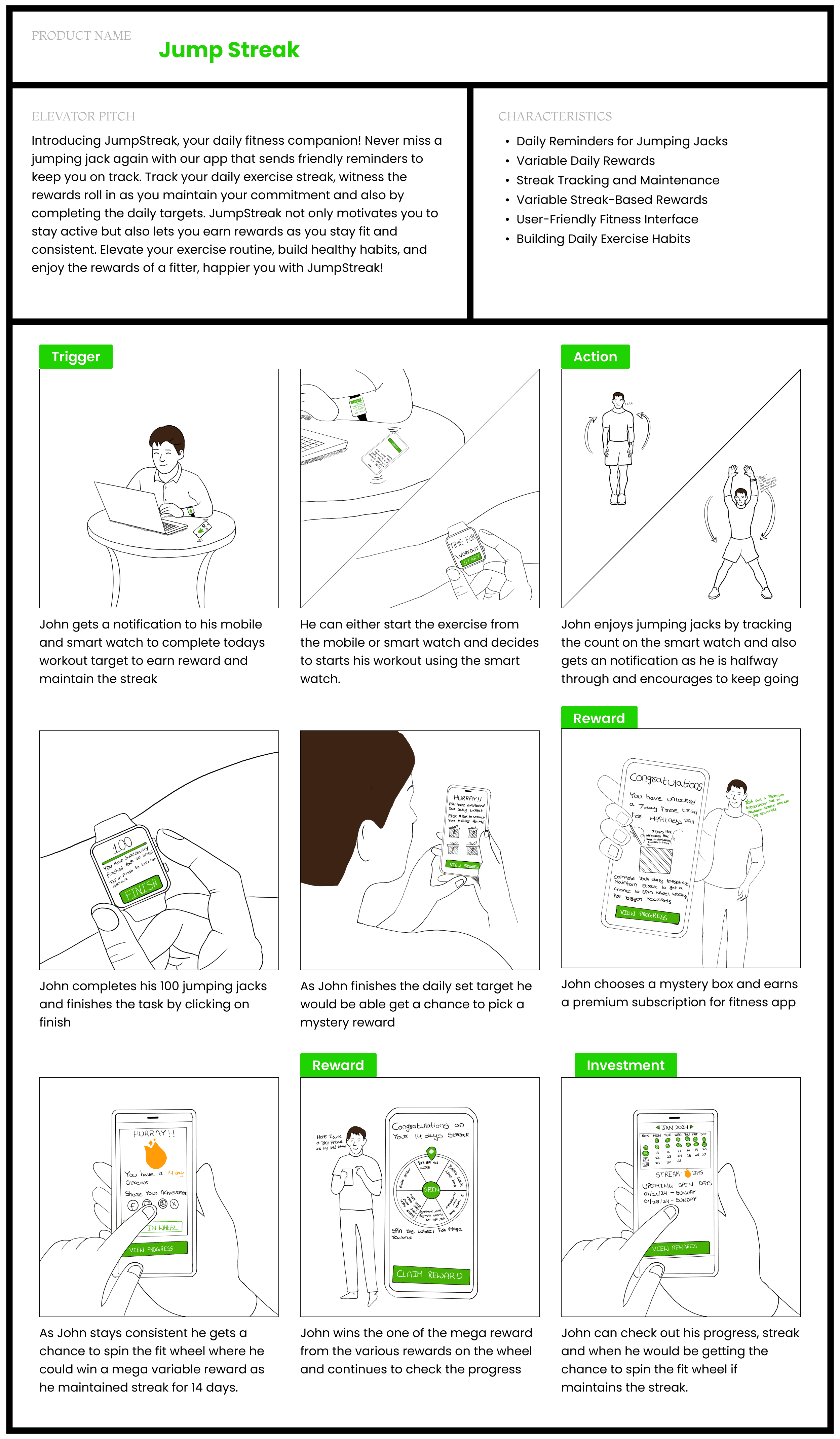
To truly understand how Jumpstreak would fit into a user's daily life and effectively apply the Hooked Model, my first step in ideation was to create a storyboard. This helped me visualize the entire user journey, mapping out every interaction and ensuring each of the Hooked Model's elements—Trigger, Action, Variable Reward, and Investment—was seamlessly integrated into the flow for a cohesive and intuitive experience.
Prioritizing Features for Impact (MoSCoW & Kano)
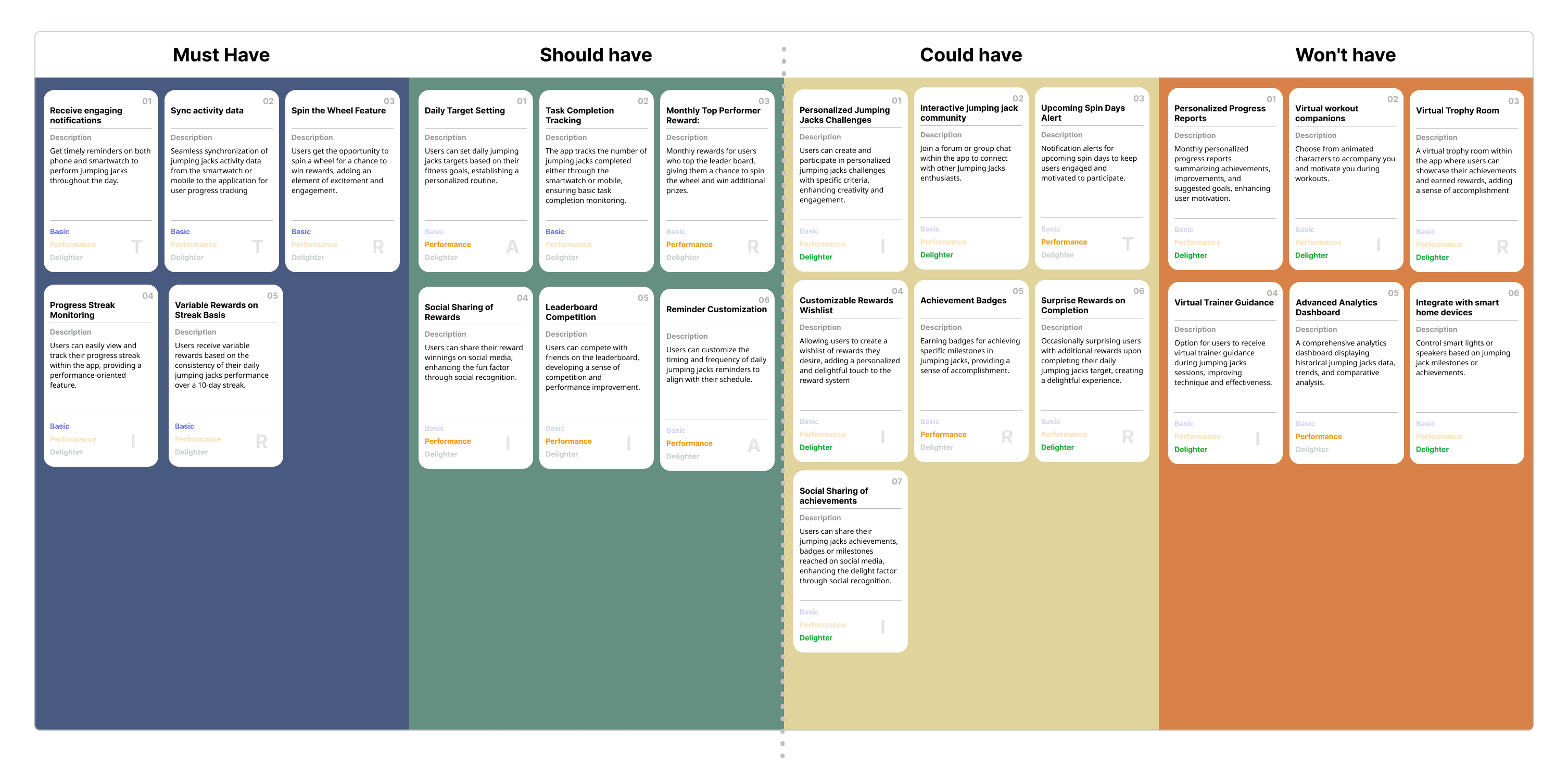
With a clear vision of the user's journey, I moved to feature prioritization. Using the MoSCoW method, informed by Kano cards, I categorized potential functionalities to ensure Jumpstreak focused on what was most essential for its core habit-forming purpose. This allowed me to prioritize features that would provide basic utility, enhance performance, and truly delight users within the academic project's scope.
Defining the Visual Voice
Before diving into screen design, I established Jumpstreak's visual identity. Starting with a moodboard based on selected keywords, I defined the app's overall look and feel. This naturally led to the creation of a comprehensive style guide, outlining typography, color palettes, iconography, and component guidelines. This systematic approach ensured a consistent and cohesive visual language throughout the entire application.

From Concept to High-Fidelity: Iterative Design
With a clear strategic foundation and visual direction, I began translating concepts into concrete designs, moving from broad strokes to fine details:
Sketching for Rapid Exploration: I started by quickly sketching out initial screen ideas on paper. These annotated sketches allowed for rapid exploration of layouts and interaction patterns without getting bogged down in digital tools.
(Place your Sketch images here)
Digital Wireframes for Structure: The paper sketches were then refined and translated into digital wireframes. This mid-fidelity stage focused purely on the functional layout and information architecture, ensuring usability and clarity before investing in visual aesthetics.
(Place your Digital Wireframe images here)
High-Fidelity Designs & Prototyping: Finally, I transformed the wireframes into polished high-fidelity designs, meticulously adhering to the established style guide. These designs were then assembled into an interactive prototype, bringing Jumpstreak to life and preparing it for testing.
Testing & Iteration: Refining the Experience
To validate Jumpstreak's design and ensure it effectively supported habit formation, I conducted usability testing with an interactive prototype. This iterative process was crucial for identifying pain points and refining the user experience.
I began by sending out a screener survey to recruit participants, ultimately selecting 5 users for the testing sessions. To ensure a comprehensive evaluation, I developed a detailed test template that covered all critical user tasks, including:
Onboarding
Performing jumping jack tasks
Checking daily progress
Collecting daily and mega rewards
Setting notification reminders
Reviewing previously earned rewards
After each session, I also asked participants to rate their overall experience and their likelihood to recommend the app to friends and family, which allowed me to calculate a Net Promoter Score (NPS).
Analyzing Feedback & Prioritizing Issues
Upon completing all 5 testing sessions, I consolidated the feedback and created a frequency matrix. This systematic approach helped me prioritize issues based on their severity and how often they occurred, ensuring that the most impactful problems received immediate attention.
Key Learnings & Design Iterations
Through these tests, I uncovered two significant areas for improvement:
Problem 1: Hidden Mega Rewards & User Awareness
Observation: A major issue was that users had no clear idea that the app offered "mega rewards" for maintaining streaks, even after going through the onboarding process. They were also unsure how to find previously earned mega rewards, as these were somewhat hidden within the notification icon on the home screen.
Iteration: To address this, I redesigned the main rewards tab. Instead of a single view, I introduced two distinct tabs: one for "Daily Rewards" and another for "Mega Rewards." This simple change made it immediately clear that mega rewards existed for streak maintenance and provided a dedicated, easily discoverable place to view all earned mega rewards.
Problem 2: Onboarding Flow Confusion
Observation: During onboarding, users were asked to input their height and weight, with different unit options (e.g., imperial/metric) presented as side-by-side tabs. This caused confusion, as users were unaware whether to select one option or if it was a default unit.
Iteration: To eliminate this ambiguity, I replaced the side-by-side tabs with a single dropdown menu for unit selection. This allowed users to clearly choose their preferred unit, seeing only that unit displayed, which significantly streamlined the input process.
Impact of Iterations
The initial testing revealed a task success rate of 85%, an overall app rating of 8.5/10, and an NPS of 40.
After implementing the identified changes, I conducted follow-up testing with 2 new users. The results were highly encouraging:
Task Success Rate: Improved to 100%
Overall Rating: Increased to 9.2/10
Net Promoter Score (NPS): Jumped to an incredible 100
These improvements clearly demonstrated the positive impact of addressing user pain points and refining the design based on direct feedback.